How to Drink a Glass of Wine by John Saker
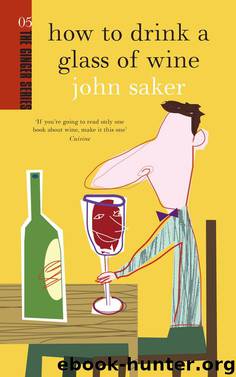
Author:John Saker
Language: eng
Format: epub
ISBN: 9781877551031
Publisher: Awa Press
Published: 2012-06-01T04:00:00+00:00
Wine … offers a greater range for enjoyment and appreciation than possibly any other purely sensory thing which may be purchased.
Ernest Hemingway
Adaptation
NO TWO GLASSES of wine are exactly the same – even when they’re drawn from the same bottle. The first glass of a young bottle of wine, for example, will often have a tight, closed quality.
And a glass of wine, left to sit quietly between sips, will change. As time passes, the flavours broaden. The differences are due to wine’s volatile relationship with oxygen, but they also reflect its chameleon-like nature. Variation is a big part of what wine is about.
This variation cuts many ways. There are obvious divisions such as red and white, and still and sparkling. Beneath these are endless subdivisions. No vintage is the same as the last. Each patch of earth, with its own climate, will lend distinctive qualities to a wine. Each cellar has its own characteristics, so that two identical bottles emerging from hibernation in different cellars may not taste like close kinfolk at all. On top of this, every wine-maker has and applies a different philosophy and techniques. All this variability prompted the great writer and wine merchant André Simon to remark, ‘There are no great wines – only great bottles.’
The sum of all the environmental factors that play a role in producing wine is encapsulated in the French word terroir. Terroir is an interesting concept. The French have proclaimed it loudly in recent years, in part because its central premise – that a wine’s character directly reflects its place of upbringing – confirms their wines’ uniqueness. And terroir works on both macro and micro levels: not only is the wine of Burgundy inimitable, so is the personality of every vineyard inside Burgundy.
But cosy and romantic as it would be to think that every glass of wine you drink connects you to a distinct plot of vines, for most of the wine consumed today it just isn’t so. The large Australian companies have a ‘to hell with terroir’ attitude. Jacob’s Creek, Yellowtail and the other monster brands are made by lumping together grapes grown all over Australia. The same is true of most of the less expensive wines everywhere, including those from New Zealand. For a wine that expresses a particular site you have to seek out what is called a ‘single vineyard’ wine. More of these are emerging as the New World’s understanding of its vineyards and wine styles evolves, but terroir is always something for which you pay a bit extra.
Finally, there is the variety of the varieties. At last count an extraordinary 10,000 different vine varieties had been identified around the world, each one with its own flavour fingerprint. I’ve tasted around 120. That doesn’t leave me with 9,880 still to find before I die, because the varieties currently being made into wine would number only between 1,000 and 1,500. French authorities have named just over 200 varieties of commercial significance in modern France.
Vitis vinifera ended up being such a fractured, multifaceted species through its powers of adaptation.
Download
This site does not store any files on its server. We only index and link to content provided by other sites. Please contact the content providers to delete copyright contents if any and email us, we'll remove relevant links or contents immediately.
Whiskies (Collins Gem) by dominic roskrow(45542)
101 Whiskies to Try Before You Die by Ian Buxton(45332)
World's Best Whiskies by Dominic Roskrow(45128)
Whiskies Galore by Ian Buxton(42177)
The Fast Metabolism Diet Cookbook by Haylie Pomroy(21265)
Chic & Unique Celebration Cakes by Zoe Clark(20163)
Craft Beer for the Homebrewer by Michael Agnew(18364)
The Bone Broth Miracle: How an Ancient Remedy Can Improve Health, Fight Aging, and Boost Beauty by Ariane Resnick(16710)
For the Love of Europe by Rick Steves(14954)
Tools of Titans by Timothy Ferriss(8605)
Chowders and Soups by Liz Feltham(8498)
A Court of Wings and Ruin by Sarah J. Maas(8124)
How to Be a Bawse: A Guide to Conquering Life by Lilly Singh(7620)
The Institute by Stephen King(7171)
Cravings: Recipes for All the Food You Want to Eat by Chrissy Teigen & Adeena Sussman(6867)
Wiseguy by Nicholas Pileggi(5951)
The Last Wish (The Witcher Book 1) by Andrzej Sapkowski(5599)
Spare by Prince Harry The Duke of Sussex(5375)
Room 212 by Kate Stewart(5293)
